
Commercial Solar Solutions in the UAE: What Makes a Project Profitable?
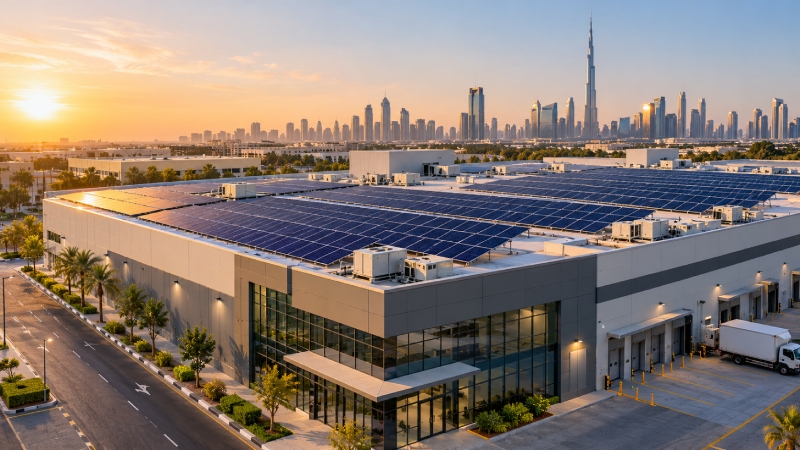
Why energy consumption, engineering decisions and lifecycle costs matter more than simply maximizing solar panel count.
Installing as many solar panels as possible may sound like the fastest route to lower electricity costs. In practice, the most attractive commercial solar project is usually the one that matches generation to a facility’s operating profile, site constraints and financial structure. For businesses evaluating commercial solar solutions in the UAE, profitability depends on much more than the size of the rooftop array.
Start with electricity demand, not installed capacity
Solar capacity is commonly expressed in kilowatt-peak (kWp), while the energy generated and consumed is measured in kilowatt-hours (kWh). These quantities are related but not interchangeable. Two facilities with similar rooftops can have very different business cases if one consumes most of its electricity during daylight and the other operates primarily at night.
Review at least 12 months of electricity bills where available, along with interval load data, operating schedules and future changes in demand. The aim is to understand how much on-site generation the facility can actually use, and how any exported electricity is treated under the applicable utility framework.
A rooftop feasibility study can change the design
Before proposing capacity, the project team needs to verify roof strength, shading, waterproofing, safe maintenance access, usable area and equipment layout. Module orientation, temperature effects, cable losses, inverter selection and the DC-to-AC sizing ratio influence practical generation. Electrical infrastructure and interconnection requirements may place further limits on design.
- Structural review: confirm allowable loads and any strengthening or mounting requirements.
- Solar resource and layout: analyze shading, available area, tilt, orientation and temperature.
- Electrical design: evaluate inverters, protection, cable routes, connection points and metering.
- Operation and safety: preserve access for inspection, cleaning, waterproofing and emergency response.
Why the largest solar system is not always the best investment
Consider a purely illustrative 500 kWp rooftop PV system producing 800,000 kWh in a year. That figure represents annual energy generation, not guaranteed savings. The value of those kilowatt-hours depends on when the building uses them, which tariff or export rules apply and what costs are incurred. If a meaningful share cannot offset qualifying on-site consumption, the financial outcome may be different from a simple generation-times-tariff calculation.
A robust commercial solar feasibility study compares expected generation against hourly demand and tests multiple system sizes rather than assuming the maximum installed capacity delivers the highest return.
Evaluate the full lifecycle, not just the quotation
A project should compare its initial capital cost (CAPEX) with predicted savings, operating and maintenance costs, component replacement allowances, performance degradation, financing and any relevant taxes or contractual costs. Depending on the market and project, lease or power purchase agreement (PPA) structures may also be considered where commercially and legally available.
Payback period is one useful metric, but it should not replace an assessment of lifecycle return, operating risk and performance guarantees. Actual results can differ from modeled results due to weather, facility demand, equipment availability and operational practices.
Factor in approvals and long-term performance
Grid interconnection, local utility approvals and rules governing self-consumption or export must be understood early. Once a project is operating, planned solar operations and maintenance (O&M), monitoring and timely fault resolution help protect the expected energy yield.
Plan commercial and industrial solar with IAN
IAN Sustainable Solutions supports commercial and industrial solar EPC projects, including site evaluation, system design, equipment selection, procurement, installation, testing, commissioning and lifecycle support. A commercially sound project begins with a technical analysis of both the building and its electricity demand.
Considering rooftop solar for a warehouse, factory or commercial property? Request a technical and commercial solar feasibility assessment from IAN.
Contact IAN Sustainable Solutions