
What is solar PV and how does it power a UAE home?
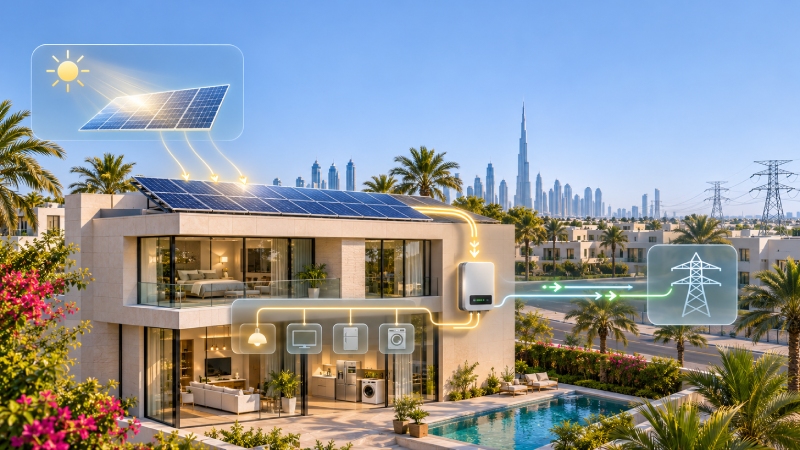
A Dubai household’s changing demand explains how panels, an inverter and the grid work together.
Solar PV stands for solar photovoltaic. The cells in a rooftop panel convert sunlight into direct-current electricity. An inverter converts it into alternating current, the form used by household appliances. In a grid-connected UAE home, the panels and the grid can supply the same building at the same time. Switching on the air conditioner works exactly as it did before.
What happens when the air conditioner switches on?
Suppose the panels are producing 4 kW at noon and the villa needs 6 kW while its air conditioner is running. With no battery supplying power, the grid provides the remaining 2 kW. Later, the thermostat switches the compressor off and household demand falls to 2 kW. If solar output holds steady, the home now has 2 kW available to export through an approved connection.
Why the bill uses kWh
A kilowatt tells you how much power is flowing at a particular moment. A kilowatt-hour tells you how much energy flows over time. In the example above, exporting 2 kW steadily for half an hour would send 1 kWh to the grid. In Dubai, the meter records imported and exported electricity under the applicable Shams Dubai arrangements.
What changes after sunset?
Once the panels stop producing, the home draws electricity from the grid or from a battery configured to supply it. Backup during a power cut is a separate design decision. A standard grid-tied inverter shuts down when the grid fails. If you want the fridge, router and essential lights to keep running, tell IAN which circuits matter and for how many hours. That gives the team a starting point for sizing backup power and storage.