
Does rooftop solar pay off for a Dubai warehouse?
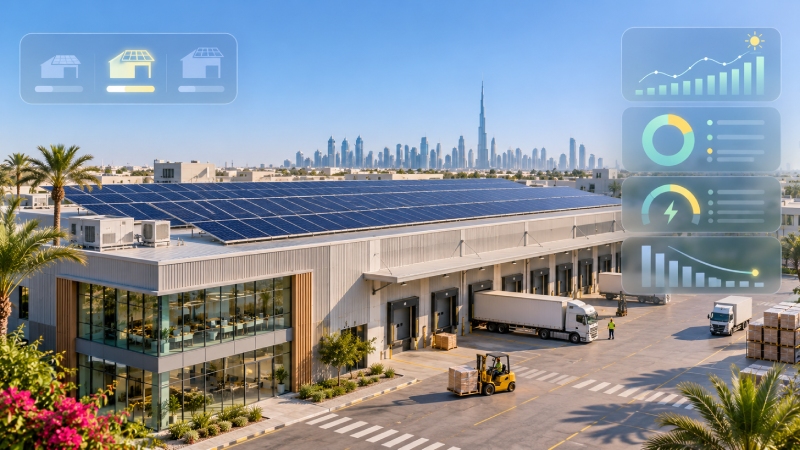
A worked example shows why a warehouse’s shift pattern can change its solar payback by years.
A cold store may run refrigeration through every sunny hour. A neighbouring warehouse may use most of its electricity to charge forklifts after the evening shift. Even with identical roofs and annual electricity consumption, these buildings can get different returns from commercial solar in Dubai. The difference is how much solar electricity each building uses while the panels are producing.
A warehouse that uses 80% of its solar production
Take a hypothetical 100 kWp system costing AED 260,000. Assume it generates 150,000 kWh in year one and the warehouse uses 80% onsite. That replaces 120,000 kWh of purchased electricity. At an illustrative avoided cost of AED 0.30 per kWh, the annual value is AED 36,000. After an assumed AED 4,000 for annual maintenance, the benefit is AED 32,000. At that rate, simple payback is about 8.1 years.
What if the afternoon shift changes?
Keep the system, price and output the same, but move enough activity into the evening to reduce direct solar use to 60%. The warehouse now uses 90,000 kWh of solar electricity onsite. After maintenance, the annual benefit falls to AED 23,000, extending simple payback to about 11.3 years. Both calculations exclude export credits, financing, equipment replacement and declining panel output. An actual proposal should use the site’s tariff and account for any eligible exports separately.
What to check before committing the roof
Request interval consumption data covering weekdays, weekends and seasonal shutdowns. Confirm the roof’s remaining life, who authorises alterations and how long the business expects to occupy the building. IAN’s Dubai portfolio includes a 125 kWp grid-connected rooftop installation at the TDRA headquarters. For a warehouse assessment, send IAN the operating schedule, electricity history and date of the next planned roof refurbishment.