
Battery Energy Storage Systems in the UAE: 5 Benefits Beyond Backup Power
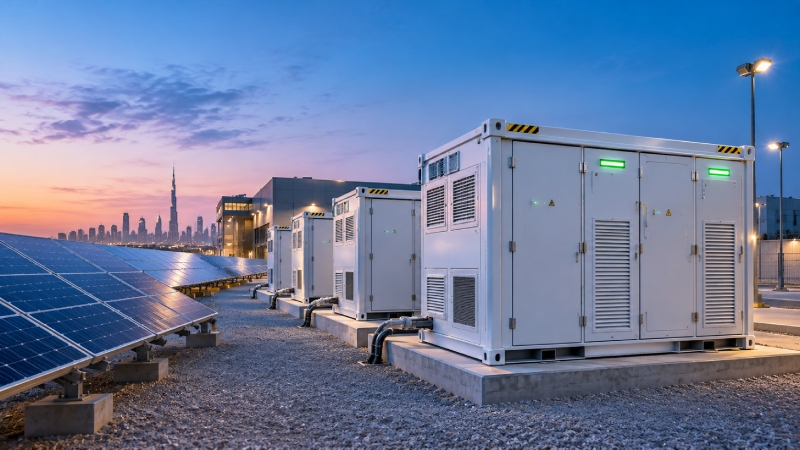
From flexible energy use to resilient operations, BESS can serve several commercial and industrial objectives when properly designed.
Battery storage is often discussed as a way to keep essential equipment running during a power interruption. Yet that is only one application. Businesses researching battery energy storage systems in the UAE may also be seeking better energy flexibility, improved solar self-consumption and more controlled operation of on-site power assets. The benefits depend on the facility’s electrical design, tariff structure and operational needs.
First, understand battery power versus battery energy
Power, measured in kW or MW, describes how much electricity a BESS can deliver at a given moment. Energy, measured in kWh or MWh, describes how much electricity it can store. A system rated at 250 kW / 500 kWh has a nominal duration of two hours at rated output, before accounting for usable capacity, conversion losses, efficiency and other operating limits. A battery’s role should therefore be defined by both required power and required duration.
1. Manage periods of high electricity demand
A BESS can discharge during short periods of high site demand and help reduce grid import peaks. This is often described as peak shaving or peak demand management. Its financial value depends on whether the applicable electricity tariff includes demand-related charges or other incentives for managing peaks.
2. Use more solar electricity later in the day
Solar PV generation and building demand do not always occur at the same time. A battery can store part of the available daytime solar electricity for later use, where system design and local rules permit. For facilities exploring solar-plus-storage systems, an hourly energy model helps determine whether the added storage capacity is useful and economically justified.
3. Support essential loads during interruptions
Correctly specified commercial battery storage can serve critical loads, such as selected controls, IT equipment or operational systems, during a supply interruption. The supported load and duration must be engineered carefully. A backup function may require additional switching, protection, inverter capability and operating controls; it should not be assumed that every grid-connected BESS can provide uninterrupted power.
4. Coordinate operation with diesel generators
In remote and hybrid applications, storage can smooth changing loads, reduce unnecessary generator operation and help coordinate solar generation with backup assets. Actual reductions in fuel use and running hours depend on generator operating limits, available solar production, battery size and the energy management strategy.
5. Enable microgrid and selected grid-support functions
Depending on power conversion equipment, communications, controls and approvals, BESS may support microgrid operation and grid services such as frequency response. These capabilities are not universal; they depend on the specific system architecture and the rules of the connected network.
What matters when specifying a BESS?
Technical selection goes beyond nominal capacity. Engineers should assess state of charge (SOC), depth of discharge (DoD), round-trip efficiency, charge and discharge rate (C-rate), battery chemistry, thermal management, battery management systems, protection, fire safety and warranties. Operating environment, usable storage duration and future expansion also influence the commercial case.
A well-designed system should start with a clear priority: energy cost management, renewable energy integration, resilience, generator optimization or a combination of these needs. Trying to optimize every objective at once without a defined dispatch strategy can undermine performance expectations.
Discuss BESS solutions with IAN
IAN Sustainable Solutions supplies and develops integrated battery energy storage solutions for commercial, industrial and larger-scale applications, including solar-plus-storage and containerized configurations. The appropriate solution depends on required kW, usable kWh, operating conditions and intended application.
Need battery storage for your facility or project? Speak with IAN about the power rating, storage duration and operating strategy your system requires.
Contact IAN Sustainable Solutions